
Cumberland Release Date Meanings
A projected date is a calculation. It reflects the sentence, credit already earned, and the correctional rules that apply at the time of the calculation. An eligibility date is different. It may only mark the point when parole consideration can begin. The actual release date and time record a completed exit from a named jail or prison. Keeping those three ideas separate prevents a future date from being mistaken for a final order or a completed Cumberland County release.
A person awaiting trial at Piedmont Regional Jail usually has no sentence-based projected release date. The next step may depend on bond, recognizance, dismissal, or another court action. Even after a judge authorizes release, another jurisdiction's detainer may require transfer instead of release to the community. A detainer is a request from another agency to hold or transfer the person. For a sentenced state prisoner, VADOC computes time. For a local sentence, PRJ and the sentencing court hold the records needed to explain the date.
Find Cumberland Release Dates
Start by deciding whether the person is in local, state, or federal custody. Cumberland County has no separate adult county jail. Piedmont Regional Jail in Farmville serves Cumberland and five other counties. Its public lookup is for people currently incarcerated under PRJ custody. VADOC handles state prison sentences and state supervision. A federal case may pass from a PRJ contract bed to the U.S. Marshals Service or the Bureau of Prisons, so roster disappearance cannot identify the destination.
- Check the official Piedmont Regional Jail offender lookup. A current result addresses present PRJ custody, not a future release promise.
- For a state sentence, search the VADOC Inmate and Supervisee Locator by name or seven-digit VADOC number. Copy the field label and note the access date.
- Check the Cumberland Combined District Court or Circuit Court when bond, sentence terms, or an amended order may control the date.
- Call PRJ at 434-392-1601 for a local sentence. Ask for the recorded release computation or booking/release entry, not an unofficial estimate.
- If the person was transferred, follow the receiving agency. A state, federal, or immigration transfer is not release to the community.
The broader Cumberland County released-inmate search explains how VINE, court records, and agency records can be combined when the name no longer appears in the current jail locator. That evidence chain is more reliable than a single missing result.
Note: Preserve the exact agency, displayed date label, and access time because online custody and supervision data can change after each update.
VADOC Release Date Fields
VADOC calls its public tool the Inmate and Supervisee Locator. It covers people in VADOC institutions and people under state probation or parole supervision. It can also cover certain people held in local or regional jails under VADOC authority. The locator is updated daily and warns that details can be inaccurate or out of date. A released state prisoner may remain visible as a supervisee, while a person who has fully discharged may no longer appear.
Search by the first three letters of the first name and the full last name, or use the seven-digit DOC number. Optional filters include location, race, gender, and age range. The public landing page says a result may provide a location and “release date.” VADOC procedure separately allows staff to release projected parole-eligibility, mandatory-parole, and good-time-release dates at the time of inquiry. Do not relabel a live field. Record what the result actually says.
| VADOC item | What it can mean | Limit |
|---|---|---|
| Release date | The date currently displayed for a covered inmate or supervisee | It may change and is not the physical exit timestamp |
| Institution location | The VADOC facility tied to the current record | A transfer can change the location |
| District location | The state supervision office after prison release | Supervision is not full discharge |
| No result | The person was not found in the public system | It does not prove sentence completion or release |
The VADOC time-computation page shows the official framework behind these dates.
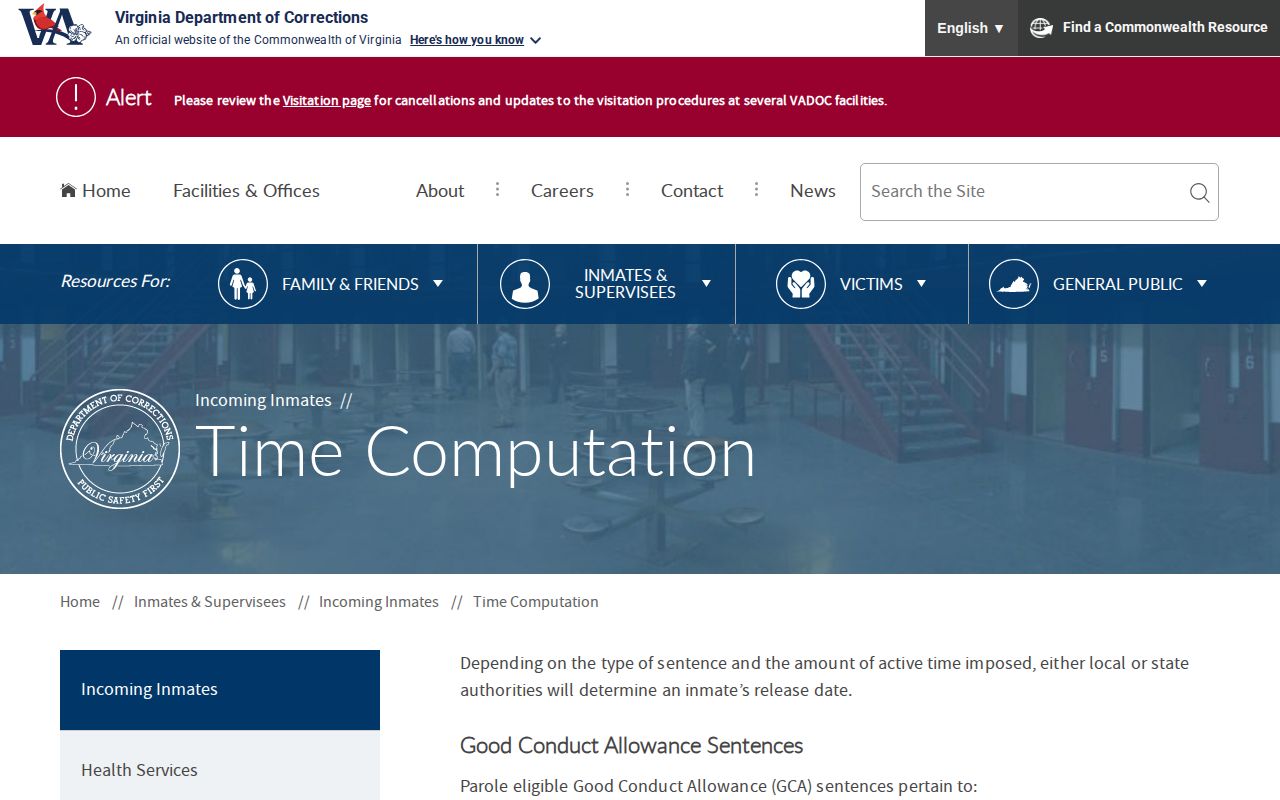
The captured VADOC page confirms that Virginia separates its credit systems by offense and sentence type rather than applying one flat percentage to every case.
Cumberland Release Credit Rules
Virginia uses both Good Conduct Allowance, called GCA, and Earned Sentence Credits, called ESC. GCA applies to felony offenses committed before 1995 and misdemeanor offenses committed before 2008. VADOC calculates active GCA sentences longer than 12 months. ESC applies to felonies committed on or after 1995, and VADOC calculates active ESC sentences longer than 12 months. The offense date and classification must be known before any credit rate is discussed.
Under Virginia Code §53.1-202.2 and §53.1-202.3, one earned credit deducts one day. Listed ESC-1 offenses can earn from zero through 4.5 days for each 30 days served. That top rate is the basis for the often repeated estimate that many post-1995 felony terms require about 85 percent service. Yet qualifying ESC-2 offenses can earn as much as 15 days per 30, based on class. One percentage does not fit all Virginia sentences.
Local jail terms follow a different rule. Section 53.1-116 allows eligible misdemeanor sentence totals of 12 months or less to earn one day for each day served when conduct is satisfactory and no mandatory minimum applies. A jailer may grant added program credit in specified cases. This does not mean every PRJ sentence is cut in half. Mandatory minimums, prior jail credit, more than one sentence, and the person's actual eligibility still control.
- Earned sentence credit
- Credit that reduces sentence time under the governing statute and earning class.
- Jail credit
- Time already spent in qualifying custody that is credited toward an active sentence.
- Mandatory minimum
- A part of a sentence that cannot be reduced by ordinary credit rules.
- Discharge
- The end of the sentence or supervision status shown by the responsible agency's record.
Note: Credits do not move a parole-eligibility date, and only the responsible jail or VADOC can confirm the official computation for one person.
What Changes Cumberland Release Dates
A release calculation changes when the facts used in it change. VADOC considers the offense date, total active sentence, prior jail credit, credit system, earning level, and later events. PRJ must also account for the court's order and any hold from another agency. A date shift is not proof that staff made an error. Compare the old and new source records before reaching that conclusion.
| Factor | Possible effect on the release date |
|---|---|
| Disciplinary credit loss | Forfeited credit can move a computed date later; restoration follows law and agency procedure. |
| Prior jail credit | Verified qualifying custody time can alter how much active time remains. |
| Court amendment | A corrected or amended sentencing order can change the term VADOC or PRJ must apply. |
| Concurrent or consecutive terms | The way multiple sentences run affects the total active period. |
| Detainer or hold | The computed date may remain, but the person may transfer to another custodian instead of leaving custody. |
| Parole action | An eligibility date begins review; even a grant does not create an immediate physical release. |
When official information appears wrong, VADOC Operating Procedure 050.6 provides a written correction route through the unit holding the record, with an appeal path. A former inactive inmate or CCAP supervisee seeking their own file may use the notarized Form 050_F17. That personal records route is not a general public request for another person's complete file.
For a permitted public inquiry, VADOC procedure allows staff to confirm limited facts such as custody or parole status, facility location, and projected parole-eligibility, mandatory-parole, or good-time-release dates. Broader imprisonment and supervision files are excluded from mandatory disclosure under Virginia law. Direct the question to the institution or probation and parole office holding the record, or use the VADOC records request channel. A narrow request for the date as maintained avoids asking staff to create a new calculation.
Cumberland Release Timing After Court
Piedmont Regional Jail adds a local timing rule that does not apply to VADOC institutions. Effective July 21, 2026, PRJ does not release offenders between 10:00 p.m. and 7:00 a.m., regardless of the reason for release. The official release-hours announcement and revised memorandum are the controlling local sources. They do not publish a queue order for releases held overnight.
A late court order and a next-morning physical exit can therefore describe the same Cumberland County matter. One timestamp reflects legal action. The other records when PRJ completed the departure. This is the distinctive local processing overlay for a Cumberland projected release date, and it must not be projected onto a VADOC prison. Call PRJ before traveling for pickup because no official exit door, waiting zone, or weekend exception is published.
Note: Ask PRJ for the actual exit timestamp when a court action and physical departure fall on different calendar dates.
Confirm Cumberland Actual Release
For a PRJ release, request the cumulative booking/release entry and the part of the individual record that states the date, time, release category, and transfer destination. The strongest local proof pairs that physical-release entry with the Cumberland court order that supplied the legal basis. The Cumberland Sheriff's Office holds sheriff-created arrest and transport records, but it does not operate the regional jail roster. Send the custody question to PRJ. For a state prison release, the VADOC facility-release process explains that a person receives a notification-of-release letter and signs the applicable release, probation, or parole document. That packet is stronger evidence than a copied locator date. VADOC states that institutional release occurs by 11:59 p.m. on the release date, weather permitting. Its rule should not be confused with PRJ's separate hours.
The VADOC release-process image below comes from that official agency page.
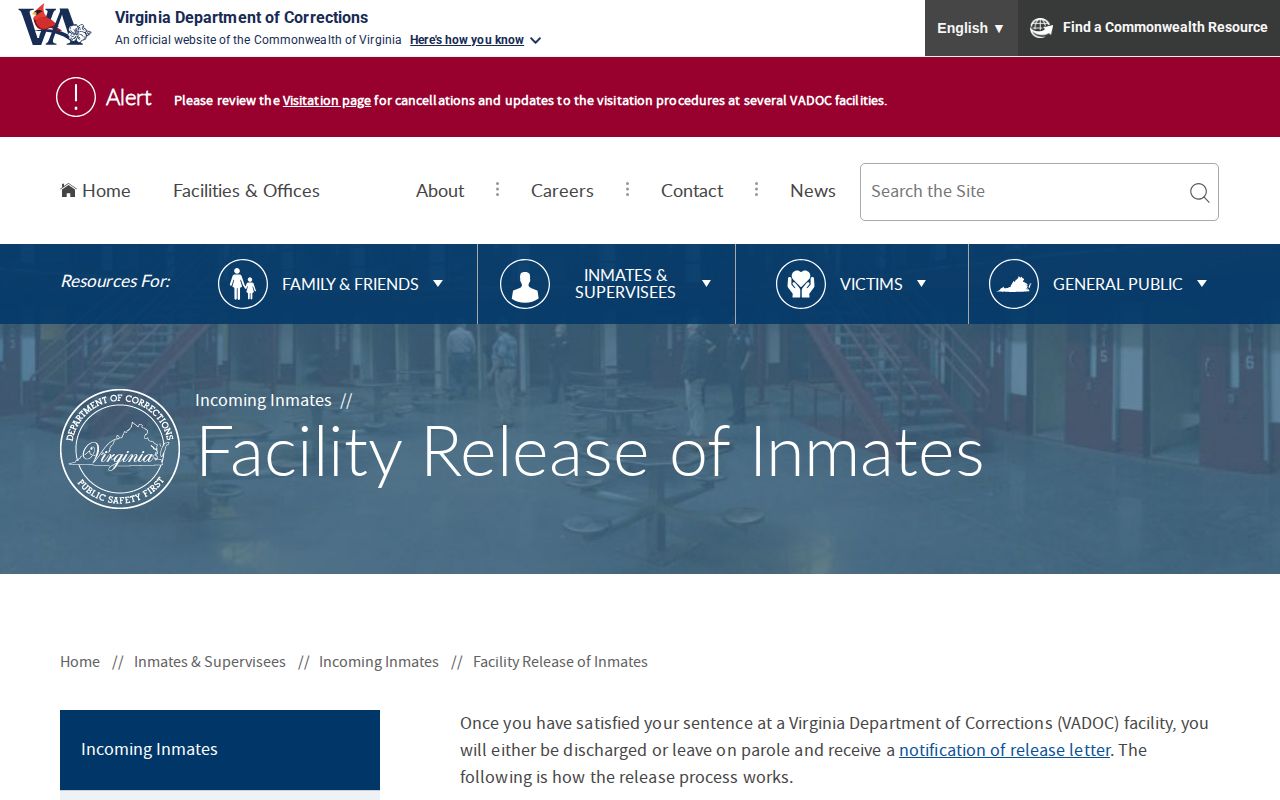
It connects the public date to the signed paperwork and release steps that complete a state custody event.
Virginia VINE can provide notice for a known person leaving PRJ, though it is not a certified release record. The VINE Inmate Check covers the local registration steps and its transfer limits. If durable proof is needed, confirm the alert with PRJ or VADOC and retain the actual agency record. A release from one custodian can be a transfer to another, so confirm the destination before describing the person as free in the community.